April 21, 2026
Free As a Butterfly: My Blindness Rehabilitation Journey
Living life differently, with Diverse Abilities.
Author

Free As a Butterfly: My Blindness Rehabilitation Journey
Editor’s note: On January 25, 2017, friends, family and members of CFB gathered at Paul’s Restaurant in Victoria, B.C., to celebrate Gina’s successful completion of the nine-month training program at the Louisiana Center for the Blind. Gina gave an interesting and inspiring presentation about her experiences there and also showed us a beautiful set of nesting boxes that she handcrafted in the woodshop while there. Chocolate cake was added to the celebration, the icing on top, cheering, “Congratulations, Gina!” Here is her journey:
Like the butterfly, I started life in a cocoon. Like that butterfly, I was able to physically leave that cocoon when conditions were perfect. But in reality, it was a mental cocoon that I needed to break out of. I was stretching, struggling, and knew that there was a bigger world out there waiting for me to discover and experience. It took strength, determination, and the willingness to risk being vulnerable within myself and with others to start the journey.
My name is Gina, and in 1992, I was diagnosed with Progressive Cone Dystrophy. This is a gradual deterioration of my central vision, and I have blind spots throughout my peripheral vision. Despite my declining sight, I have been working in the restaurant industry for the last 27 years and managed as a single parent to raise a smart, capable, and beautiful daughter. In 2015, I accepted the fact that I was losing my vision, and that was the moment I took the initiative to break out of my mental cocoon.
I had made acquaintances with two independent, confident, and self-motivated blind women whose skills for managing life with blindness were inspiring. It was these women who encouraged me to gain my own non-visual techniques so that I could not only change my destiny but also embrace it with joy and wonder.
Elizabeth Lalonde is one of those women. She started and is the director of the Pacific Training Centre for the Blind, a part-time blindness training program here in Victoria, B.C., which I signed up for. Danielle Frampton (Fernandez) was an instructor at the same centre, and she introduced me to sleepshades (a blindfold) and the techniques for holding my white cane.
The latter was a bit of a struggle with pride for me, as I did not want to draw attention to myself. As I used the cane more, I felt confident, and for the first time in a long time, I was walking with ease. I stopped looking down all the time and let the cane be my guide through curbs or any other obstacles in my path.
I also started to study Braille and became familiar with screen reader applications for computers that dictate text aloud. I had definitely gained skills and built up my confidence; however, due to each of the classes having a short duration and only being biweekly, I feared that I would not be able to learn enough to be prepared for my life without vision.
Much to my shock and dismay, I found out that there were, in fact, no full-time training programs in this field available in Canada. The only option available, if I wanted to learn these very important life skills in a timely manner, was to look to the United States, where there are 3 training centres of the National Federation of the Blind (NFB). I chose the Louisiana Center for the Blind (LCB) as it is very reputable, and it was also where Danielle and Elizabeth -- who had both inspired me so much -- had received their training.
LCB is a privately operated residential facility that is staffed primarily by highly qualified professionals who also happen to be blind. This centre provides a very innovative orientation and rehabilitation training program, with a positive philosophy around blindness being an integral part. This centre has been recognized not only on a national level, but internationally as well. Its positive philosophy plus its mandate is to provide its students with the confidence to experience life to its fullest via five main areas of instructional focus: independent cane travel, computer skills, home economics, reading and writing Braille, home maintenance and woodshop.
Right from the beginning, I was confronted with huge challenges in making arrangements to go, as there were numerous obstacles that needed to be overcome. This program is not covered by any of our country’s numerous healthcare or social programs, so I had to provide the funds to achieve this training on my own. I live in subsidized housing that has very stringent rules regarding tenants not being allowed to leave their suites vacant longer than a six-month duration, and the training I needed was 9 months. In addition to this, I was told by the B.C. Ministry of Social Services that if I left the province for more than 30 days, I would forfeit any benefits that I would receive from them.
Thankfully, with the assistance of an advocate, I was able to fight for this, which I feel should be a right to all Canadians confronted with this situation, as it allows one to live independently, care for, and provide for oneself. It was a battle well worth fighting, as in the end, I was eventually given the green light by the government and my housing management to go and not lose everything in the process.
The training program carried a hefty price tag of $3,500 per month. Thankfully, being an international student, the centre only required me to pay $1,000 US per month for training. On top of the tuition, I was responsible for travel costs, medical insurance, day-to-day living expenses, as well as my rent and other expenses back home in Victoria, which totalled approximately $28,000.
On April 4, 2016, I started attending the Louisiana Center for the Blind. I had asked for more intensive training, and that’s definitely what they were providing, to the point where initially I found it almost overwhelming. But I was determined.
The housing we were provided was an ordinary two-bedroom apartment about 3/4 of a mile from the training centre, and we were paired with a fellow student as a roommate. At first, we were shuttled back and forth to the centre by bus until the instructor was satisfied with our abilities, and then we were kicked off the bus and required to travel by foot regardless of weather conditions. I was required to wear sleep shades for the duration of my training in order for me to truly experience how to do things as a blind person. I admit, it was quite scary at first.
It’s kind of funny – we all think of America as being the source of so much of our popular culture and a lot of the products we use on a daily basis; however, there was some culture shock involved in my moving to Ruston, Louisiana, by myself. Leaving behind my daughter, boyfriend, family, friends, as well as the job that I had worked at for 27 years, was definitely breaking out of my comfort zone and a little frightening. I’ll admit, there were some tears and overwhelming emotions on an almost daily basis for the first few months.
Training was very hard work, physically and mentally, while still being 100% worth it. I felt the only way to develop as a person was to go through a metamorphosis: breaking free from our cocoons and facing the challenges that we are confronted with. Luckily, in addition to my own personal strength, I was provided with a top-notch support system. My new team and I pushed ourselves constantly as we passed both small and large milestones – and with time and practice, practice, practice, the tears and frustration faded.
Now I would like to share in detail what each of the centre’s five areas of focus entailed.
Cane Travel
Cane travel consisted of learning how to correctly hold and manipulate a white cane to maximize awareness of obstacles and other things that can be used to direct oneself. I did have a bit of an advantage in this area as I had previously received some training from the Pacific Training Centre for the Blind. I was able to quickly adapt to the new cane techniques I was learning, such as “the pencil grip” and “open palm”. Once I felt satisfied with my abilities indoors, I ventured outdoors, where I went from simply walking back and forth in front of the centre to actually crossing streets and finding addresses. We crossed the massive Interstate highway and service roads, which were scary propositions – even for people with full sight. Feeling the direction in which the sun’s warmth hits us is a means to position ourselves to use cardinal directions (North, South, East and West). In addition to that method, we collect information from other stimuli to use as landmarks, such as smells, sounds and ground textures that we detect with our canes.
Once you have fully familiarized yourself with the city, you are given your first of four drop routes. On your first drop, you are accompanied by your instructor. After that, you’re on your own. The location you’re dropped at is completely unknown to you, and it is your task to return to the centre without the help of any technology or help from people, such as asking for directions. This is all in preparation for two final major assignments, which are a 10-kilometer solo journey in Ruston, and a trip to another foreign city – planned completely independently and unescorted. For the out-of-town trip, you are required to use public transit and visit two different destinations while there. You are provided with $150 for transportation and the same amount for accommodations. I chose Shreveport, Louisiana, for my adventure and while there, visited a restaurant that had been recommended to me and a visit to a spa. At the beginning, I was terrified, but then referred to my training and all was well. The sounds and the traffic then became friendly guides helping me to walk straight and safely cross roads while on route to my destinations.
Computer Technology
Computer technology is where they teach you to utilize a PC without a screen or mouse. We learned to navigate a computer using only keyboard commands and a screen reader. I found this to be particularly difficult as I had to rely on my listening skills and really concentrate because the computer voice was somewhat difficult to understand. I found that I was jumping the gun a lot and making my keystrokes before listening to everything being said. After time and, yes, practice, things clicked for me and the next thing I knew I was writing in Microsoft Word, copying, pasting, creating files, surfing the web and corresponding with people via email. Prior to this training, I was using a text magnification program called ZoomText for a limited number of things and relied heavily on desktop shortcuts that a friend had set up for me. I am now able to navigate a computer more independently.
Home Economics
Home economics was where my cooking skills took a gigantic leap forward. I had, of course, always prepared basic meals for my daughter and myself, but nothing so elaborate or on a scale this large. Within no time, I was preparing entire meals from scratch. There was a huge list of prerequisite dishes to prepare before heading into our final assignments. These dishes were: roasted chicken, casseroles, stews, soups, cakes, cookies, waffles, bread, pizza and even ice cream. The equipment we were taught to use included: gas stoves, deep fryers, clamshell grills (like the one George Foreman made famous) and rice cookers. We used a talking thermometer to check our temperatures. We used completely unmodified equipment while cooking. That’s right, real fire from hot coals or gas in our barbeques.
After mastering a myriad of recipes, it was then time for our first big assignment, which was to prepare a multi-course meal for 8 people. This was to be all my doing, completely from start to finish – meaning, I had to shop for all the ingredients, prepare the multi-course meal and beverage, then serve it. In addition, I had to do all the cleanup afterwards. For this assignment, I served crackers with cream cheese and peppered jelly, spinach salad, beef stroganoff with egg noodles, and warm garlic and herb whole wheat buns. For dessert, I served warm chocolate brownies topped with vanilla ice cream and fresh strawberries. My drink was a Shirley Temple, Canadian style.
My final assignment was to do the same thing again, but this time for 40 guests. Once again, I was solely responsible for this project. The only difference is that it was served buffet style, with the students and staff serving themselves. For this meal, I served chicken and vegetable Thai curry on rice, spinach, strawberry and almond salad with raspberry vinaigrette, and five loaves of focaccia bread (one of them gluten-free). I made two pans of brownies, plus one more pan of diabetic-friendly brownies–and strawberry lemonade to wash it all down.
Other helpful things we learned in home economics included how to write and sign one’s name, how to iron and fold laundry, thread a needle, sew on a button, do a hemming stitch, tie a tie, tie and polish shoes, light a candle and write out a budget. When we weren’t at the centre, we were also responsible for the cleaning and maintenance of our apartments, which were inspected for grading every 2 weeks.
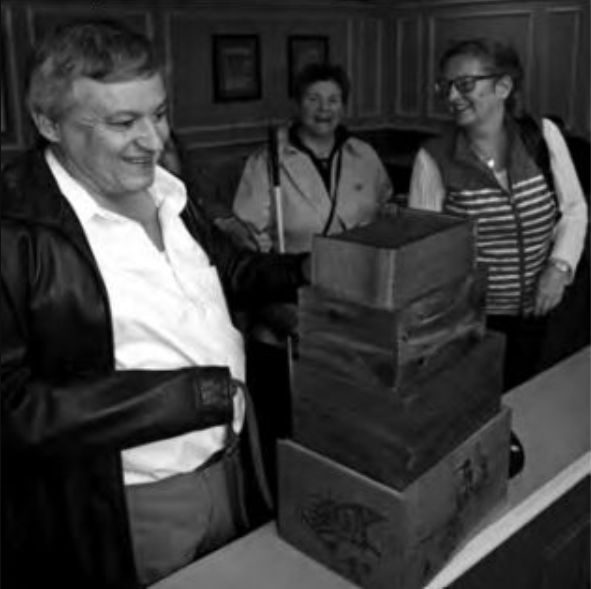
Oriano Belusic, Doris Belusic (centre), and Thelma Fayle admiring Gina’s woodwork.
Photo Credit: Daryl Jones
Braille
Braille starts with an excellent introductory book called McDuffie Reader. It goes through letters, numbers, punctuation, and the system of contractions. Once you progress past this primer, it’s time to pick your own selections to read, which allow you to improve your speed. I must admit, out of all the training I received at the centre, this one posed the biggest challenge. I found the dots difficult to feel with my fingers. I can recite their placement, but perhaps after 27 years of slinging hot plates, my fingertip sensitivity may not be that acute. I am able to write with the standard slate and stylus method. I flip the paper over, inserting it into the slate, and make indents on the back of it from right to left with the stylus. After completion, the paper is taken out of the slate and reversed so that the dots may be read from the front of the page, left to right. I can now label my spices, write out recipes or take notes. Reading and writing definitely are not my favourite pastimes anymore, but I’m grateful to have this ability for practical purposes.
Home Maintenance and Wood Shop
Out of all the training I received at the centre, this was my favourite. I really enjoyed the woodwork portion of class. It felt really rewarding to be able to make something with my own hands. Starting right at the basics, we learned how to use a click ruler, which is the equivalent to a measuring tape. Then we learned how to safely operate a variety of power tools that are not modified for blindness in any way. Tools like radial arm saws, table and band saws, routers, sanders, planers and joiners. After being introduced to all the tools, we started a small woodwork project just to further acquaint ourselves with the tools and machinery.
Then, studies took a turn into the area of actual household maintenance and repairs for a while. The scope of this class was amazing, and as a result, I feel better equipped to take care of things in my home. We were shown how to change a deadbolt and door handle lock, label an electrical box, hook up a clothes washer and dryer, plus how to turn off a gas valve at the meter. The next thing I knew, I was a lady plumber. I can unclog a sink or toilet, remove the elbow joint in a drain to retrieve lost jewelry. I can even change the parts inside my toilet tank should it start acting up!
Once we feel at home with the woodworking tools, we do a timed project similar to the previous project, but with different measurements. For our final assignment, we were given free choice. I wanted something that I could bring home with ease, so I chose to make a set of nesting boxes, each having 1/8 of an inch clearance between them. I loved this class so much that I did not want to leave. My set of four nesting boxes turned into a pair. In the end, I made 13 boxes. My instructor said that I have sawdust in my veins!
In addition to all the classroom lessons, the centre also took us on a number of field trips that one would better describe as real-life adventures, which demonstrated to each student that we are just as capable out in the world as people with vision are. Of course, this had a very positive effect on our self-esteem, and we flourished within our support system. During the month of August, we visited Tennessee, where we played paintball, ran a ropes obstacle course, went whitewater rafting in class-four rapids, plus hiked to the top of Lookout Mountain. We ventured to Arkansas in October, where we hiked up a mountain, climbed a rock face near the top, then rappelled down it, rode a 2,300-ft zip line and went horseback riding while staying at the Horseshoe Canyon Ranch. All of these adventures were reality lessons teaching us that despite not being able to see, we are strong, smart and independent people who are capable of doing almost anything if we don’t allow fear to set limits for us.
On December 16, 2016, my dear friend, Patrina, and I graduated together. The graduation ceremony is a huge affair. We sat at the front of the library with the Director of LCB, Pam Allen, while she spoke of our journey to the centre, our training and future plans. Next, all the instructors spoke about our presence in their classes, our struggles and joys. After that, fellow students had the opportunity to share stories, comments, and memories. Then it was my turn to speak and share with everyone.
The ceremony is our personal affirmation of all we accomplished. I cried with pride for each grad. I knew what they had to go through to get to that stage – a lot of hard work mentally, physically and emotionally. We all received an engraved freedom bell with our name and graduation date. Afterwards, we trooped outside to ring the centre’s big brass bell 31 times (one ring for every year open). Then the graduates chose a restaurant, and everyone was welcome to go.
I’m grateful that The Blind Canadian magazine has allowed me to share my experiences at the Louisiana Center for the Blind. My wish is to stimulate discussion amongst the powers that be in Canada, and that they will, in turn, encourage every blind citizen to live the life they want and can, with independence and pride. I want to effect change for future generations, giving them what they need to create and fulfill their own dreams. We need to use our voices now to educate the government, teachers and the general public about the state of vision impairment in Canada. Our Canadian society has such low expectations of our blind citizens. We have been enabling many of our blind by sheltering them or placing them into group homes. Let’s better prepare them for life and direct them toward universities and colleges and into well-paying jobs. There is no reason why we cannot have training centres in Canada staffed with the same caring, competent professionals that I have encountered in the United States. Prior to meeting Elizabeth and Danielle, I was unaware I had options – and now I feel like the sky is the limit and that I’m as free as a butterfly.
I want to thank everyone who has helped make this training possible for me. Thank you to the Canadian Federation of the Blind, Thelma, Daryl and to everyone who donated to my GoFundMe campaign. Thank you to my family and friends and to my Louisiana Center for the Blind family. Thank you for your support. I’m truly blessed! If I can inspire and encourage even one caterpillar to make a leap of faith, breaking free from their cocoon, then I will feel all my hard work was worth it!
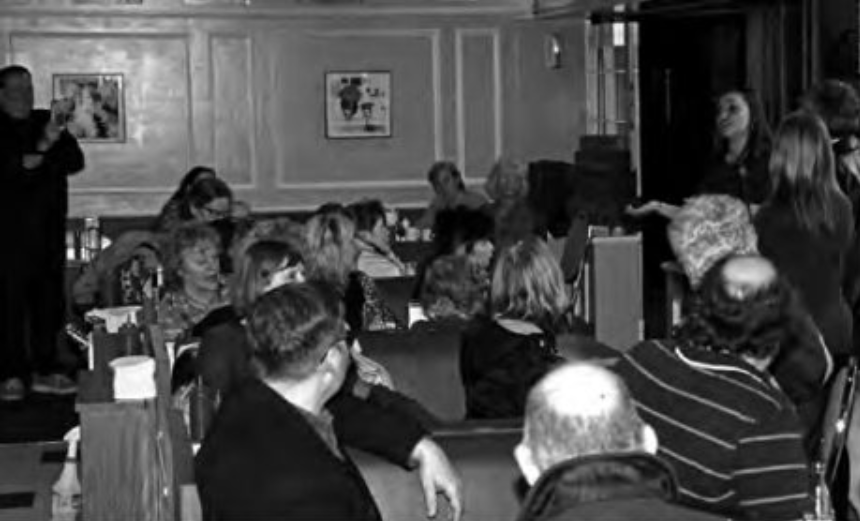
Gina Martin speaking at Paul’s
Restaurant, January 25, 2017.
Photo Credit: Daryl Jones
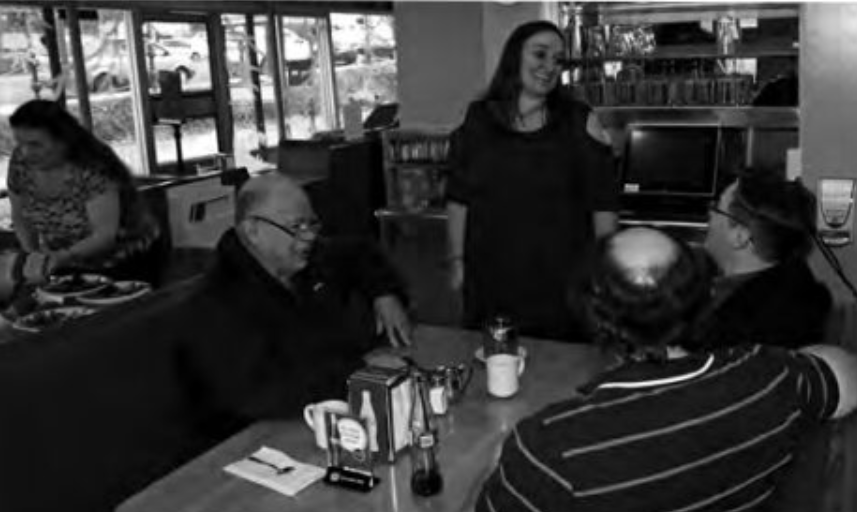
Gina Martin speaking at Paul’s
Restaurant, January 25, 2017.
Photo Credit: Daryl Jones