
April 21, 2026

Identifying Currency

Living life differently, with Diverse Abilities.

Author

Diverse Abilities Programs Inc.

Share

Money is only good if you know what it is!

In Canada, if you are someone who has limited vision or is totally Blind, our Canadian currency is easy to figure out the denomination. Every bill is identifiable.


We can tell from the font size, different colours, and the tactile markings of Braille. It makes it easy for the blind community to independently navigate and know what denomination we have or are giving and receiving. 


Our bills are made of plastic and are all the same size and rectangular shape. The bills are 3 inches high by 6 inches long. The printed numbers on each bill are 1 inch by 1 inch in diameter, making it more visible for someone with low vision to read. 


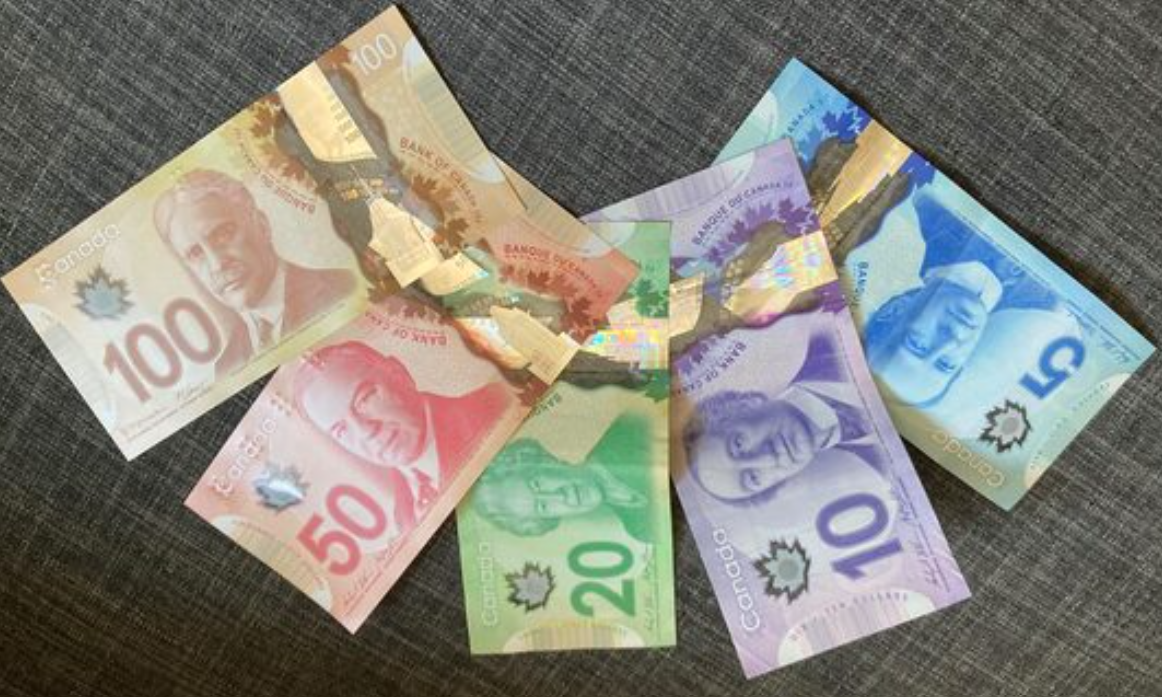
Having coloured bills is an easy way to identify which bill it is. Each denomination has its own specific colour.  Our $5 Canadian bill is blue, our $10 is purple, our $20 is green, our $50 is red, and our $100 bill is brown.


If someone is colour-blind, then the large print or the tactile markings may be helpful. 


A lot of Canadians do not know that there is Braille on our money.  It is not what the Braille says but where it is placed that we identify what it is.


Braille is a tactile method of reading. Raised bumps allow people to read with their fingertips. A full Braille cell consists of six dots. Dots 1,2,3 go down on the left side, and dots 4,5,6 go down on the right.  We use these to read and write. Within the six dots, using different configurations, you have all the letters of the alphabet, numbers, and contractions.


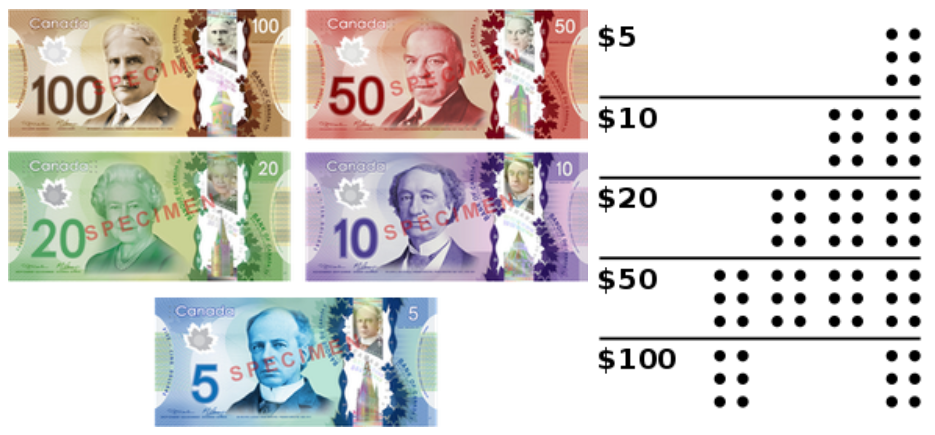
All Braille is found and felt on the top left-hand corner of our Canadian bill. 

  • The blue $5 bill there is 1 full Braille cell (6 dots in a up and down rectangle).
  • On the purple $10 bill, there are 2 full Braille cells spaced 1 cm apart. 
  • The green $20 bill there are 3 full Braille cells, spaced 1cm apart.
  • With the red $50 bill, there are 4 full Braille cells, spaced 1cm apart. 
  • Finally, on the brown $100 bill, there is a full Braille cell in the first position and another in the fourth position. Meaning there is a full Braille cell, then a space of 3cm, then another full Braille cell.


Bottom line, without using any vision, everyone can identify what bill(s) they have.


Below is a photo example of Canadian currency and the Braille cells on each bill.

I do not go into the bank often, but when I do, I always ask the teller if they know how to read the Braille on our money. So far, everyone I have asked has said "no”. Hmm... they know now (smile).


We no longer have $1 or $2 bills; we have coins instead. Our $1 coin is bronze in colour and is called a loonie. Our $2 coin is silver in colour, with the centre of the coin being bronze with different images. We call the $2 coin a toonie.


I can decipher the difference by running my fingers around the edge of the coins. A toonie has ridges all around the edge, while the loonie has flat edges along its side, like an octagon.


All our coins are slightly different in size. The toonie is the largest, with the loonie being just slightly smaller. Our 25-cent coin  (quarter) is the next size down, followed by our 5-cent (nickel), and our smallest coin is the 10-cent (dime). We do not have a 1-cent coin (penny) anymore. All amounts are rounded up if  3 cents or above and rounded down if under 3 cents when paying with cash.


Our debit cards and credit cards are also another form of currency. Pin pads with buttons are accessible because there is a Braille dot on every #5 pin pad, which allows us to navigate the pin pad. There is also a tactile marking on the "ok" button.


Touch screens are not accessible to me and take away my independence. Most people do not realize that change is not always best for everyone.

What I have done to help me identify my card is to put a piece of tape on the front of the card, opposite the end of the chip where my thumb holds the card when I insert it. I also put a piece of tape on the back side of the card opposite the swipe strip. The tape is placed where my thumb holds the card. That way, I know I have the strip facing the right way.


I also use this method when given hotel keys (tape under where my thumb holds the card to unlock the door).


I enjoy travelling, but have only dealt with a couple of different currencies. When I was in Europe, there was the Euro and every bill and coin are different in size, allowing me to identify their money well.


In the United States, American money is all the same size, colour and has no tactile markings. I fold my bills differently to identify what denomination they are, and I am hopeful that people are honest in telling me the correct bill they give me in change.


For a one-dollar bill, I fold it width-wise and then width-wise again. For a five-dollar bill, I fold it width-wise and then length-wise. For a ten, I fold length-wise and then width-wise. For a twenty, I fold length-wise, then I fold both sides in and meet in the centre. For a fifty, I fold length-wise, then width-wise, then width-wise again, making a square. For a hundred, I fold both sides width-wise into the centre, then I fold the bill width-wise again. My friend also uses this method, only she folds her bills in a manner that works for her to remember.


There are money readers that some people use, or apps on smartphones that tell you what money you want to know. Unfortunately, technology is not always available, so having a manual method to fall back on is very important. There are many ways to do things, so find what works most efficiently for you.


These hacks may take us a little longer than others, but it does give us our independence.


April 21, 2026
Chairs are more than just somewhere to sit.
April 21, 2026
What I wish I had known when I was first diagnosed.
April 21, 2026
All we want is to be seen as a person, not just our disability. 
April 21, 2026
Something really beautiful happened recently, and I’ve been sitting with it .
April 21, 2026
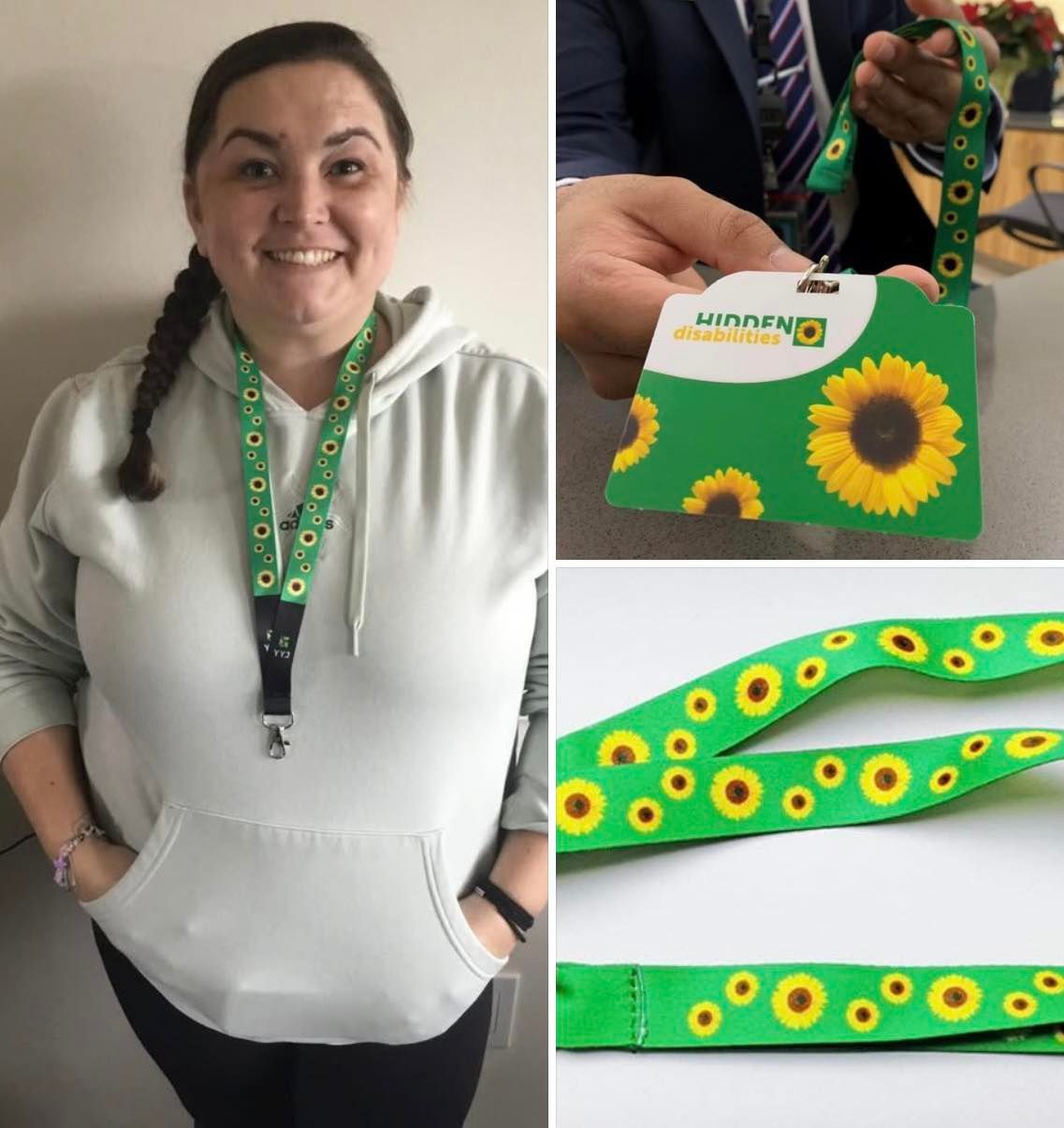
Hidden Disabilities Sunflower: For People Living With Hidden Disabilities

April 21, 2026
Feel Confident Navigating & Travelling Around The City

April 21, 2026
Discovering How ADHD Shaped My Experiences
April 21, 2026
What if creating an inclusive workplace was easier than you thought?
April 21, 2026
In life, three barriers often prevent people with disabilities from fully participating in various activities: Social stigmas, attitudes, and misconceptions about our abilities. The built environment and the lack of accessibility.  Ourselves, which includes fear of the unknown, fear of failure, and lack of confidence. While we may not always be able to change the first two, the third barrier—our mindset—is one that only we can break through. In 1992, I was diagnosed as legally blind due to Progressive Cone Dystrophy. But it wasn’t until 2015 that I fully embraced my blindness. Rather than saying, "I’m losing my sight," I reframed it as, "I’m gaining my blindness." This shift in mindset allowed me to step out of my comfort zone and explore non-visual techniques to complete tasks I once relied on sight for. Patience, time, and yes, frustration, were all part of the process. But now, I’m living my best life—doing even more than I did with vision. When friends asked me to go axe 🪓 and dagger 🗡️ throwing, I immediately said yes. I love new experiences, and I wasn’t going to let my blindness be a barrier. We spent an hour learning how to hold, aim, and throw. I chose to wear a blindfold because the small amount of vision I have left can be more distracting than helpful. My focus wasn’t on whether I got a bullseye but on having fun, being included, and trying something new. After all, we never know if we’ll like something until we try. For this experience, the target was about 15 feet away, with chain fences on either side. I could stretch my arms out and feel both fences, giving me a sense of space. There was also a tactile line under my feet, ensuring I knew where to stand. To throw the axe, I gripped the bottom of the handle with my dominant hand (right) and placed my left hand over my right. I raised the axe over my head, letting it rest between my shoulder blades, squared my body to the target, relaxed my shoulders, and threw. I hit the target most times and even landed two bullseyes! It was exhilarating. My husband and friends joined in by donning blindfolds and throwing axes, too. Even the staff took part in the experience, and we all had a blast. The dagger 🗡️ proved more challenging. To throw it, I had to position the tip of the blade pointing toward me, over my shoulder, next to my ear—a nerve-wracking task without sight. I threw it four times and managed to hit the board once (the handle stuck, not the blade, but close enough for me to laugh about it). While I enjoyed trying it, I much preferred the axe and will definitely be doing that again. This experience reinforced the idea that people with disabilities may not always meet others where they are—but that doesn’t stop others from meeting us where we are. It’s not about the perfect experience; it’s about trying and enjoying the process. So, step out of your comfort zone. You may discover something new and, most importantly, have fun.
April 21, 2026
Are they really accessible for everyone to use? Here's a simple tip to make your business more accessible: