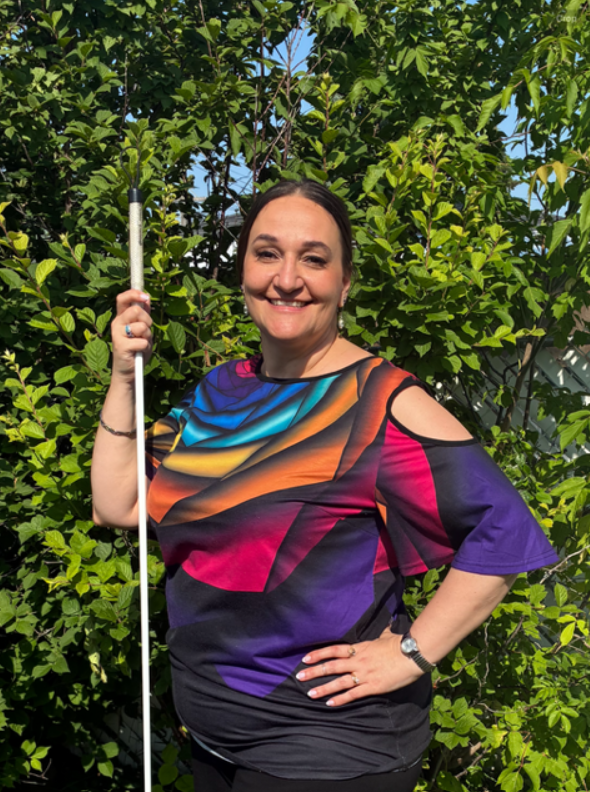
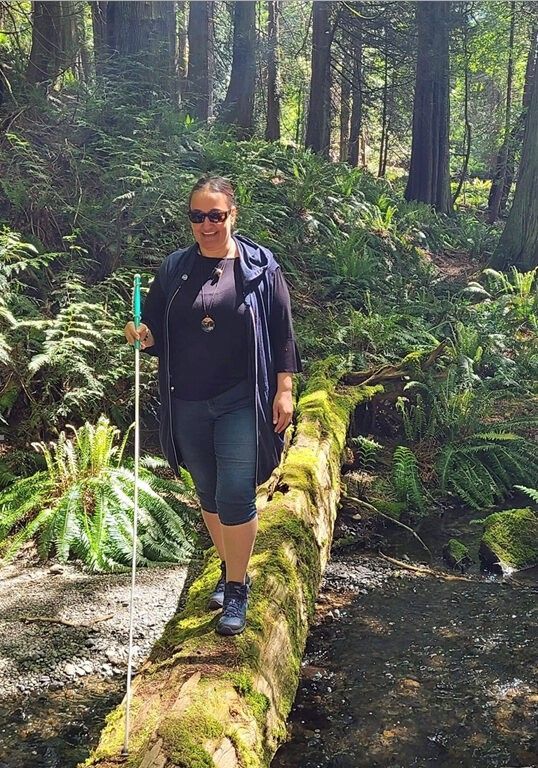
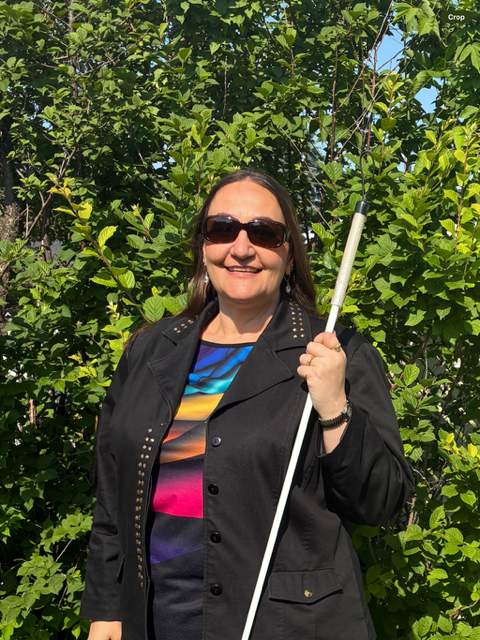
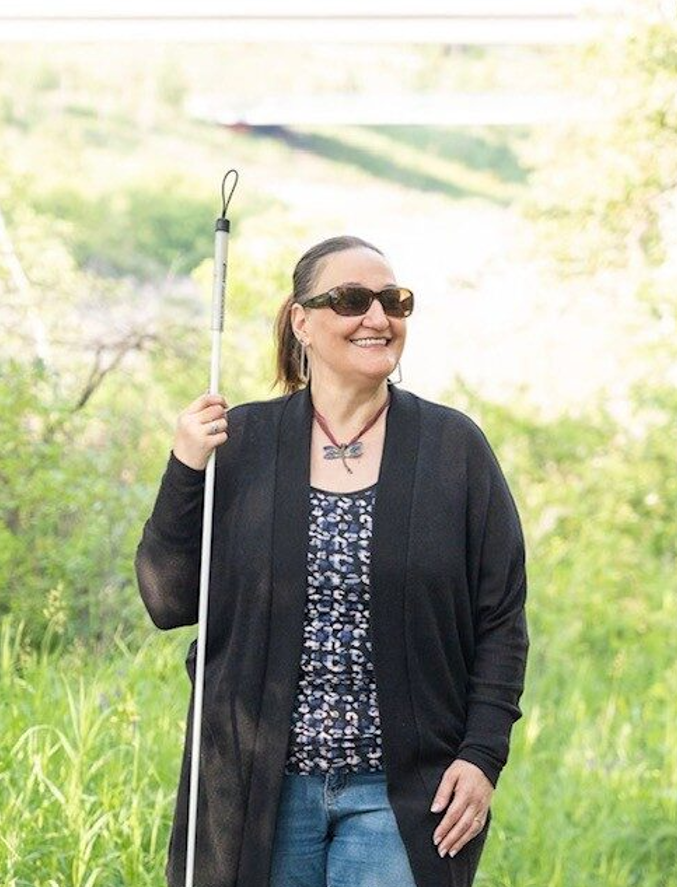
I used to fear the idea of using a white cane and drawing attention to myself. Today, this white cane represents my freedom.
Navigating with no sight is possible if you have these tools in your belt!
My cane is an extension of me! I use it to detect objects that I can’t see or have difficulties seeing. The tapping of my cane against objects alerts me before I bump into them or trip over something. Tapping against different objects creates different sounds. When I am out for a walk, my cane taps a garbage can, then a couple of steps further, a bus shelter, then a metal pole. Each is made of metal, yet they each sound differently.
There are certain techniques I use when I hold my cane. One is called “open palm”. This is when my palm faces up, the cane gently rests in my palm, and my thumb and pinky gently push my cane from side to side. My hand holding the cane is positioned in front of my belly button. My elbow is close to my side. My arm and wrist are relaxed and only move when I am reaching out to explore my environment, or when I am looking for something specific. By holding my cane at bellybutton level and swinging my cane evenly, I can walk straight! I swing my cane shoulder-width from side to side.
I use either the tap-and-slide method or constant contact. The timing I use is when my left foot is forward, my cane is to my right. When I step right, my cane crosses my body to my left. Being able to transition quickly and smoothly between open palm and my other grip, called the “pencil grip” took some practice. When in tighter places or in crowds, I slide my hand about 1/4 the way down my cane, pulling the tip closer to my toes so that I don’t trip anyone. I hold my cane like a pencil, between my index and middle finger. I always use this grip when I am following behind someone, in a line, or when walking where there are lots of people. I lift my cane slightly off the ground (1-2 inches) and swing it like a pendulum in front of my feet to ensure a clear space to step. I also use this grip when walking upstairs.
I like options. I personally love the straight white cane known as the Bob Riley or Commander! The straight canes are longer and lighter than the traditional Ambutech canes that the Canadian National Institute for the Blind (CNIB) provides. The extra length allows me to explore more of my surroundings. It also gives me two full steps to stop or to move around an obstacle in my path, before I run into it.
These styles of long white canes have flexibility and are easier for me to maneuver. This is because they do not have the additional weight of extra metal between each break and joining part with accessories that folding canes have.
I tend to walk quickly. When my cane catches something, it has the flexibility to bend so that I don’t walk into the end of my cane and jab myself in the stomach. The straight cane has a metal tip. This metal tip helps me to detect the different textures under it, which I can feel and hear. The material of the carbon fiber cane with the metal tip creates a vibration through the cane, which tells me the texture of what it is contacting.
If I am walking on a sidewalk and approaching an intersection, I can tell when it transitions from the sidewalk to the road when there is no curb. (Roads are travelled on more, so they are smoother.) The folding Ambutech cane tip is usually a ball that rolls over surfaces, and I find it makes it harder to detect seams and to distinguish the difference between surfaces. There are also ceramic tips. I have only tried them once and found that I did get very good information from them.
Having good mental mapping skills makes it easier to navigate independently. Will you try this for me, please? Close your eyes and picture your home. Now, picture walking up to your front door. Open it. Which direction does your door swing? Go inside, close the door, and take off your shoes. Next, picture yourself walking to your kitchen. You grab a glass from the cupboard and go to the sink for some water. Next, you walk down the hall to the living room and have a seat on your couch. Ok, could you picture yourself doing this in your mind? If you could, then you can mentally map! If you couldn’t, then I will teach you how to do this.
Familiarize yourself with your surroundings.
Whether inside or outside, it helps to know where you are. It is necessary to know your cardinal directions (North, East, South, and West). It is very important to know how to use the sun’s positioning in the sky to help me figure out the direction I need to be going. The sun rises in the East and sets in the West. In Victoria, the sun is positioned slightly south. If it is mid-afternoon and I needed to be going North, the sun would be on my back left shoulder and upper left forearm. If I wanted to go East, then the sun will be on my back.
When you understand how the address system works, it makes it easier to find your destination. For example, in downtown Victoria, mile zero starts at Dallas Rd. Paul’s Restaurant (where I worked) was on the 1900 block of Douglas Street. So, it was 19 blocks from Dallas Rd! Store Street starts at the 400 block and gets higher as you go East. On the North and West sides of the street, the numbers are even. On the South and East sides, they are numbered odd.
People who have never driven or who are blind need to understand how traffic moves and flows. Learning how to really pay attention by listening to what the traffic is doing is key! The next time you find yourself at an intersection, and you are not in a hurry, please try closing your eyes and just listening. Listen to everything going on around you. At first, it will be a lot of loud noises, and it does sound scary. There are noisy trucks and motorcycles, cars honking, construction, and other surrounding noises. Try focusing and paying attention to the direction traffic is flowing. Listen to the cars slow in front of you and hear the idling engines. Notice the cars in front of you start to accelerate. Then notice your parallel traffic idling. Sometimes I need to stand at an unfamiliar intersection for 2-3 sets of lights to figure out for sure when it is safe to cross.
There are many types of intersections! You may come across 3, 4, or sometimes 5-way lighted intersections. There are 4-way stops, T crossings, roads with left turn signals, one-way streets, and bike lanes. Some intersections have a “chirping bird” audible signal. They chirp a certain way to differentiate when it is safe to cross either East/ West or North/South. When you hear cheep cheep, it is safe to cross over the North/South running streets. If you hear coo coo, it is safe to cross over East/West running streets.
Knowing and really understanding traffic, road crossings, your body position for placement and alignment, good cane technique, and paying attention to your surroundings, is how to be a confident traveller. This is how I travel safely and have an understanding of where I am and where I am going!
I hope that this will explain some of the things that my students will learn from me!
When a caterpillar begins its transformation, it will be scared and at times it will be difficult. It prepares itself for a new life, and the next thing it realizes is that it’s soaring and finding its own way!